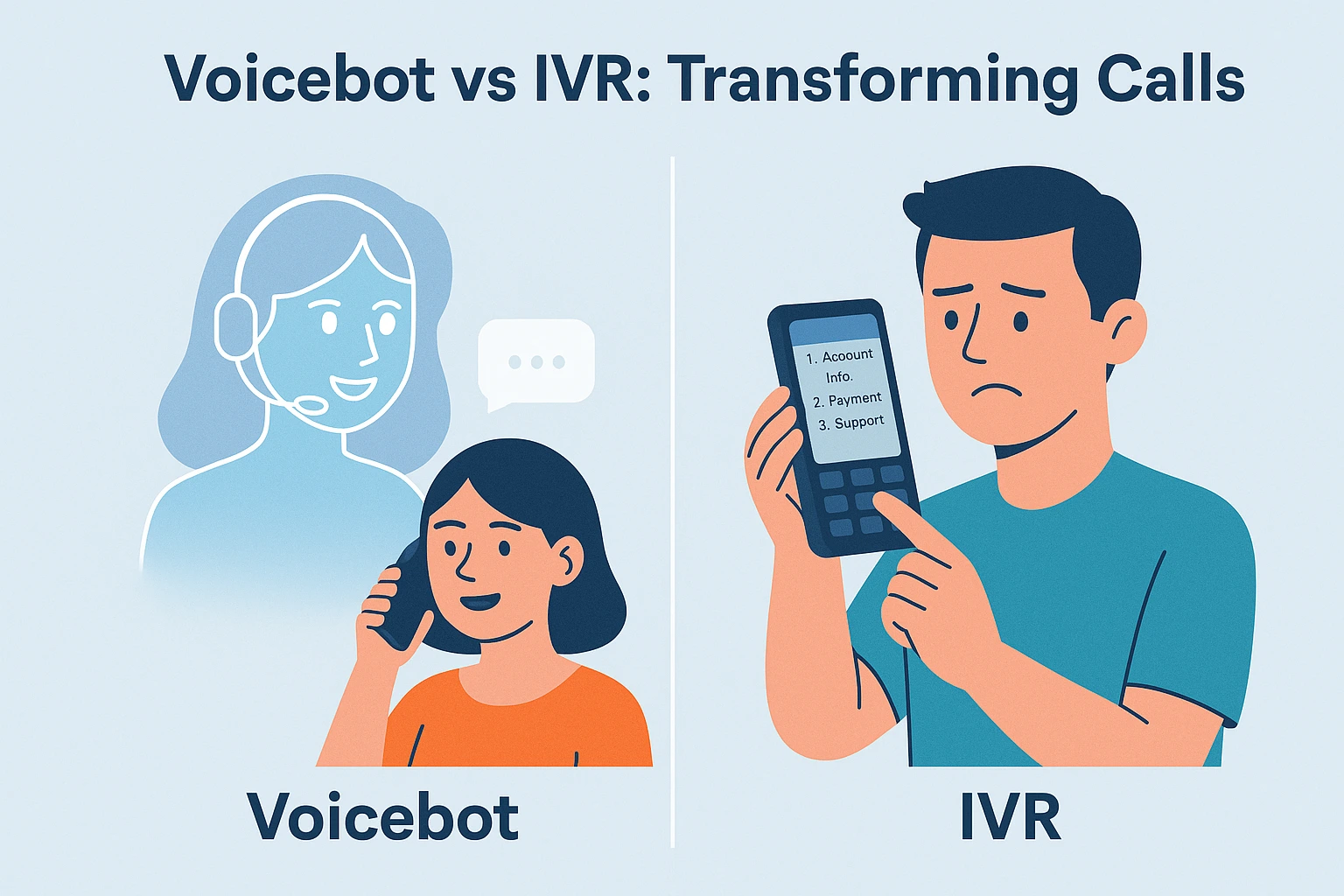
When Businesspeople discuss enhancing customer experience. Voicebot vs IVR debate takes center stage. For decades, Interactive Voice Response (IVR) systems have permitted businesses to manage heavy call volume with ease. But today, customers want more than automated voice and time.-consuming button-pressing menus. They are looking for human-like and natural conversations that settle their issues in real time.
That's when AI-driven voice solutions step in. Voicebots marry AI-powered voice automation, Natural Language Processing (NLP), and real-time learning to provide frictionless, personalized dialogue. They don't simply route calls; they capture emotion, context, and intent.
PowerDialer.ai is rewriting the equation by swapping out antiquated IVR systems for smart, conversational AI. Companies that are using PowerDialer.ai are experiencing lower call handling time, higher engagement, and satisfied customers.
What Is an IVR System?
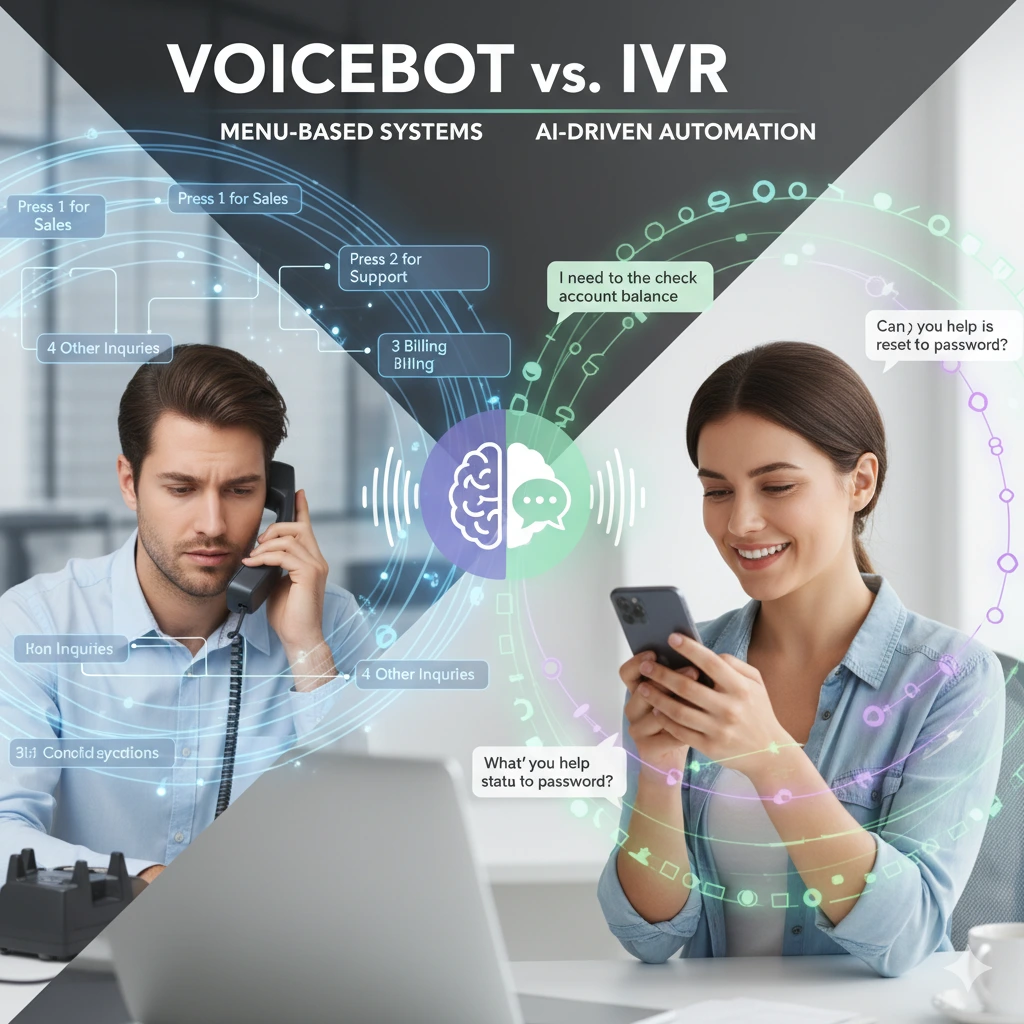
Voice Interactive Response (IVR) is an aspect of telephony technology that enables customers to communicate with a firm's phone system using voice commands or a keypad. If you call your bank and you hear, "Press 1 for account details, Press 2 to talk to an agent," that's IVR.
Its main function is to manage calls effectively, capture caller details, and perform simple interactions without humans. This positions it as one of the first automated customer interaction technologies meant to save time and reduce call center workload.
Advantages of IVR
Cost Savings on Operations:
IVR can handle several calls at a time, thus cutting down the number of support teams needed. This saves on overheads and maximizes operational efficiency.
24/7 Availability:
Customers can access assistance at any time of the day, even after office hours, through self-service facilities.
Uniform Responses:
IVRs offer uniform responses, and hence every caller receives correct and uniform information.
Scalability:
IVR solutions can handle thousands of calls simultaneously, and hence are appropriate for high-call-volume businesses.
Integration with Legacy Systems:
They integrate very well with legacy-type PBX or call center systems.
Limitations of IVR
While IVR is beneficial, it also suffers from pain points that affect customer experience automation:
Complex Navigation:
Customers are lost in convoluted menu trees and have to punch in random numbers just to speak with an agent.
Limited Personalization:
IVR does not recognize emotions or intent; it can only read scripts.
High Drop-Off Rates:
Frustration with automated messages results in call abandonment, damaging brand reputation.
Legacy IVRs cannot interpret voice tone, sentiment, or caller satisfaction.
In brief, as much as IVR did its time, today it is no longer commensurate with the level of customer expectation or the next-gen voice communications era.
What Is a Voicebot?
How Voicebots Work with AI and NLP
A Voicebot is an AI-powered intelligent virtual assistant based on voice automation and Natural Language Processing (NLP). Unlike IVR, a Voicebot can comprehend human voice, tone, and intent, having a real, two-way conversation. For instance, you don't hear "Press 1 for Support," but just say, "I need support with my account," and the Voicebot gets it and responds.
Voicebots employ machine learning, speech recognition, and NLP to understand user intent, retrieve information from CRMs, and respond conversationally, as a well-trained human representative would.
Important Voicebot Benefits
Natural-Like Interaction:
Voicebots emulate natural conversation patterns, so customers enjoy a more relaxed and smooth conversation.
24/7 Availability with Context Awareness:
Voicebots recall past interactions and tailor future responses, unlike IVR.
Decreased Wait Time
Voicebots can take multiple calls simultaneously, cutting queue times by an enormous amount.
Smart Learning:
Over time, they get smarter by learning patterns, becoming more accurate with every call.
Global Language Support:
PowerDialer.ai voicebots can communicate in different languages, making them ideal for global companies.
Improved Conversion Rates:
In sales and marketing, voicebots nurture leads, answer objections, and walk the prospect through automatically.
Voicebot in Action
Voicebots are already transforming industries:
- Sales Teams: Qualifying leads, demo scheduling, and follow-up management.
- Customer Support: Handling mundane questions and keeping agents free for complex issues.
- Healthcare: Appointment and reminder scheduling.
- Finance: Authenticating users and enabling secure balance checking.
With AI-driven voice calling, business communication in the future is more human than ever — without increasing manpower.
Voicebot vs IVR: A Comparison of the Two
User Experience
- In Voicebot vs IVR, experience matters.
- IVRs are rigid menu-based, whereas voicebots permit free-flowing, natural conversation. No more "stuck" customers; they feel understood.
- Voicebots also sense emotion and urgency, and respond accordingly in tone, something an IVR simply cannot replicate.
Operational Efficiency
- Legacy IVR systems need to be set up manually and maintained regularly. Voicebots, on the other hand, update automatically with AI updates. Intelligent routing is one of the features they support, routing customers straight to the correct agent or department based on context.
- Not just efficient, but also increases first-call resolution rates.
Technology Integration
IVR systems are generally standalone products, whereas voicebot technology today is embedded with CRMs, analytics tools, and ticketing systems. PowerDialer.ai, for example, embeds directly into your sales stack, making every interaction data-driven.
Scalability and Cost
While IVRs are cheaper to deploy, AI voice solutions generate more long-term ROI because they are automated, self-taught, and yield higher conversions. Companies save more as voicebots reduce the load from agents and improve overall call center performance.
How PowerDialer.ai Is Revolutionizing Customer Calls
AI-Powered Voice Automation
PowerDialer.ai brings advanced AI voice automation to life, turning every inbound or outbound call into a personalized experience. Its AI engine understands tone, urgency, and sentiment in real-time, helping agents respond intelligently.
Seamless CRM and Sales Integration
PowerDialer.ai’s system connects effortlessly with popular CRMs. This means agents see full caller history, previous interactions, and context before answering, improving productivity and closing rates.
Intelligent Call Routing
With smart call routing, calls route to the best agent or auto system. The result: faster resolutions, reduced transfers, and a smoother experience for every customer.
AI Coaching and Live Insights
Live calls receive AI coaching from PowerDialer.ai, providing better responses, tone adjustment, and conversation prompts. Imagine an in-the-moment coach on every call.
Proven Results
- Businesses that use PowerDialer.ai have experienced:
- 40% boost in first-call resolution rates
- 30% improvement in customer satisfaction scores
- 50% reduction in the average call handling time
Schedule a free demo with PowerDialer.ai today and discover how AI can revolutionize your communication process.
Why New-Age Businesses Choose Voicebots Over IVR
Enhanced CX (Customer Experience)
It goes without saying that voicebots win hands down in the Voicebot vs IVR scenario. They can read intent, personalize responses, and adjust based on customer emotions — providing a human-like experience each time.
Quicker Resolutions
Voicebots detect problems immediately using intent recognition and AI-driven voice automation, cutting out time on complicated menus.
Data-Driven Decision Making
Managers receive real-time insights from PowerDialer.ai analytics about call patterns, agent activity, and customer sentiment. These provide better insights to refine scripts, train employees, and optimize total customer experience automation.
Deploying a Voicebot Solution within Your Organization
Assessing Current Communication Workflows
Begin by observing how your current system processes incoming calls. Pinpoint routine tasks that can be automated, like FAQs, appointments, or lead qualification.
Adding PowerDialer.ai Voicebot System
It's easy to install. PowerDialer.ai's cloud solution can be integrated in hours, so teams can begin implementing AI-powered voice solutions instantly.
It's easy to scale, meaning you can begin small and incrementally add more as your customer base grows.
Training Teams for AI-Driven Communication
Even as automation is mighty, human touch is needed. PowerDialer.ai assists teams in striking a balance between AI-powered calls and real human empathy, reaching the ultimate hybrid communication model.
Schedule a demo with PowerDialer.ai and discover how simple it is to introduce AI voicebots to your process.
The Future of Voice in Business
The future is hybrid, the convergence of automation and empathy. Call center conversational AI is the new normal for businesses that wish to scale without sacrificing quality.
Soon enough, call AI chatbots will be engaging with customers on autopilot, anticipating needs, and providing solutions in real-time before problems even occur. And with PowerDialer.ai, that future is here, with intelligent, next-generation voice communication that's human-like.
Conclusion
Voicebots are not merely substituting for IVRs; they're revolutionizing the business of interaction.
With PowerDialer.ai, you can smartly automate customer dialogue, increase response rates, and spur satisfaction without losing the human touch.
If you are still on legacy IVR technology, it's your time now to move up. AI voice automation isn't the future; it's transforming the face of customer interactions right now.
Watch PowerDialer.ai and schedule a demo to feel the voice communications of tomorrow.
FAQs
Q1. What's the key differentiation between IVR and Voicebot?
IVR is rule-based and follows fixed scripts, while Voicebot uses AI and NLP to understand speech, emotion, and intent for more natural responses.
Q2. How does PowerDialer.ai’s Voicebot improve customer experience?
It personalizes every conversation, routes calls intelligently, and provides real-time insights that improve satisfaction and reduce wait time.
Q3. Is Voicebot technology expensive to implement?
No. Solutions such as PowerDialer.ai provide cost-effective, scalable contact center automation for startups and enterprises.
Q4. Can voicebots totally replace IVR systems?
Yes, in general, but a hybrid model is better for businesses with simple and complicated workflows.
Q5. How do I begin with PowerDialer.ai's Voicebot solution?
You can also ask for a free trial or demo right at PowerDialer.ai and observe how voice automation with AI can revolutionize your call center operations.